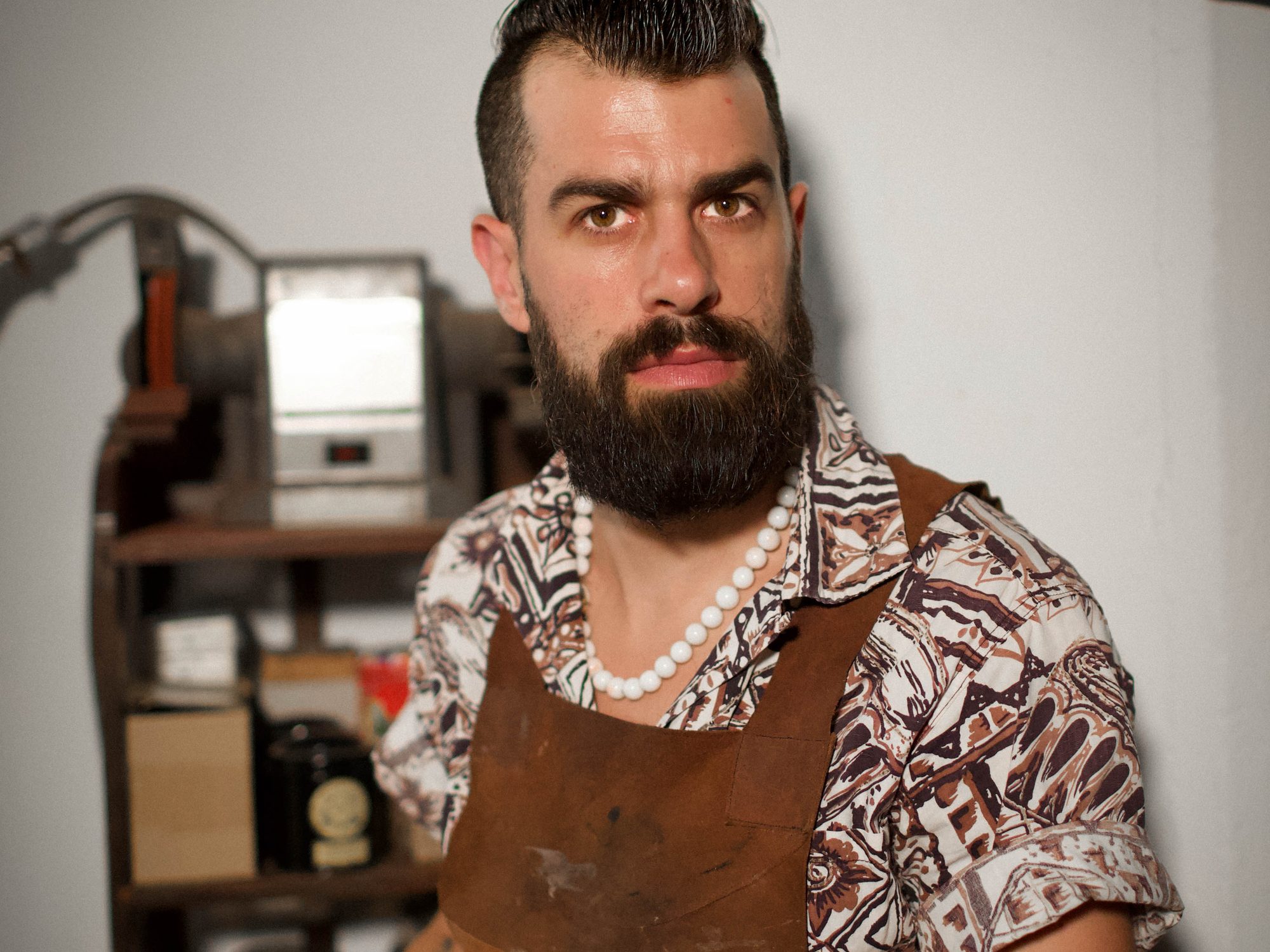
Francis Waplinger — Reworking the Italian Tradition in Brooklyn
Published: 2026-08-15/Last updated: 2026-08-15/Author: Masayuki Kaneko
This article was produced by The Makers Guild from first-hand information gathered in a direct interview with Francis Waplinger, together with officially published information.
In bespoke shoemaking, tradition is not a single block. Which lineage a maker inherits, and where he deliberately departs from it: that choice reveals a maker’s thinking more clearly than anything else. Francis Waplinger, a bespoke shoemaker in Brooklyn, New York, builds on the Italian methods he learned in Florence and layers American vintage design over them.
The words he works under are “Bespoke Shoes Handcrafted in New York City.” Prices start at $6,000 for bespoke shoes, with a lead time of around 16 months. The work is carried out at his workshop in Industry City, Brooklyn, where two apprentices assist him. On each final pair, 95 percent of the work is his own. Men’s shoes are the core of the work, and he also takes bespoke commissions for women.
Wooden Pegs in the Waist | One American Element in an Italian Method
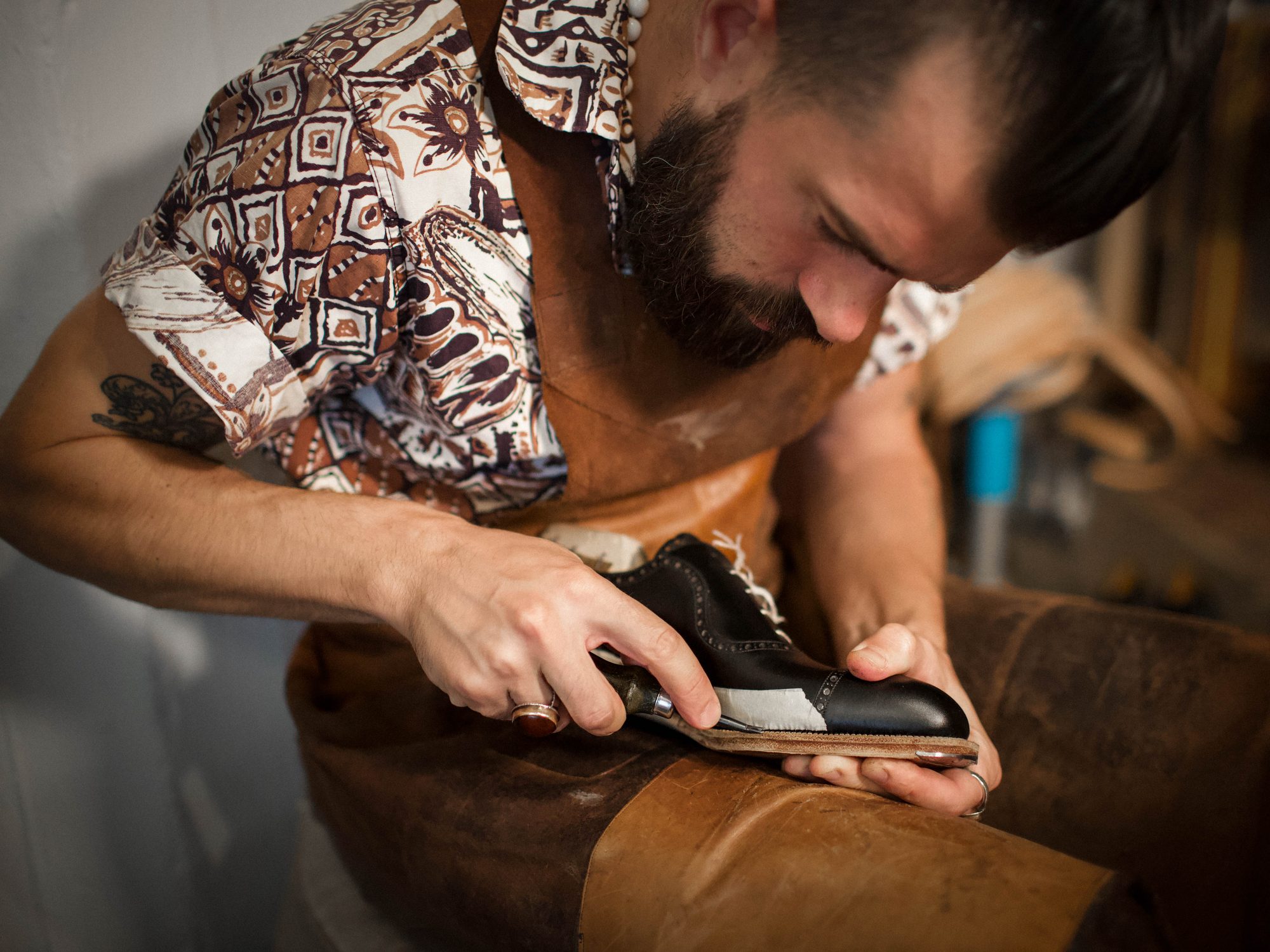
The core of Waplinger’s shoes is a construction that adds a single element of American bootmaking to traditional Italian methods. It sits under the arch, in the waist of the shoe, where it cannot be seen.
“The shoes are constructed using traditional Italian methods that have been passed down from maker to maker. The one thing I do differently, which is from the tradition of American bootmaking, is to use wooden pegs in the construction of the waist of the shoes.”
So Waplinger says. Faithful to the system he learned in Florence, he replaces one point with the accumulated craft of his own country. What shapes this workshop’s thinking is that he can state exactly what he inherited and what he changed.
The construction is built around hand-lasting and hand-welting. Seen as a piece of craft, it is a structure that places techniques of different origins where they do not show. The bottom-making, including the hand-sewn welt, is carried out one pair at a time.
American Vintage as the Source of Design
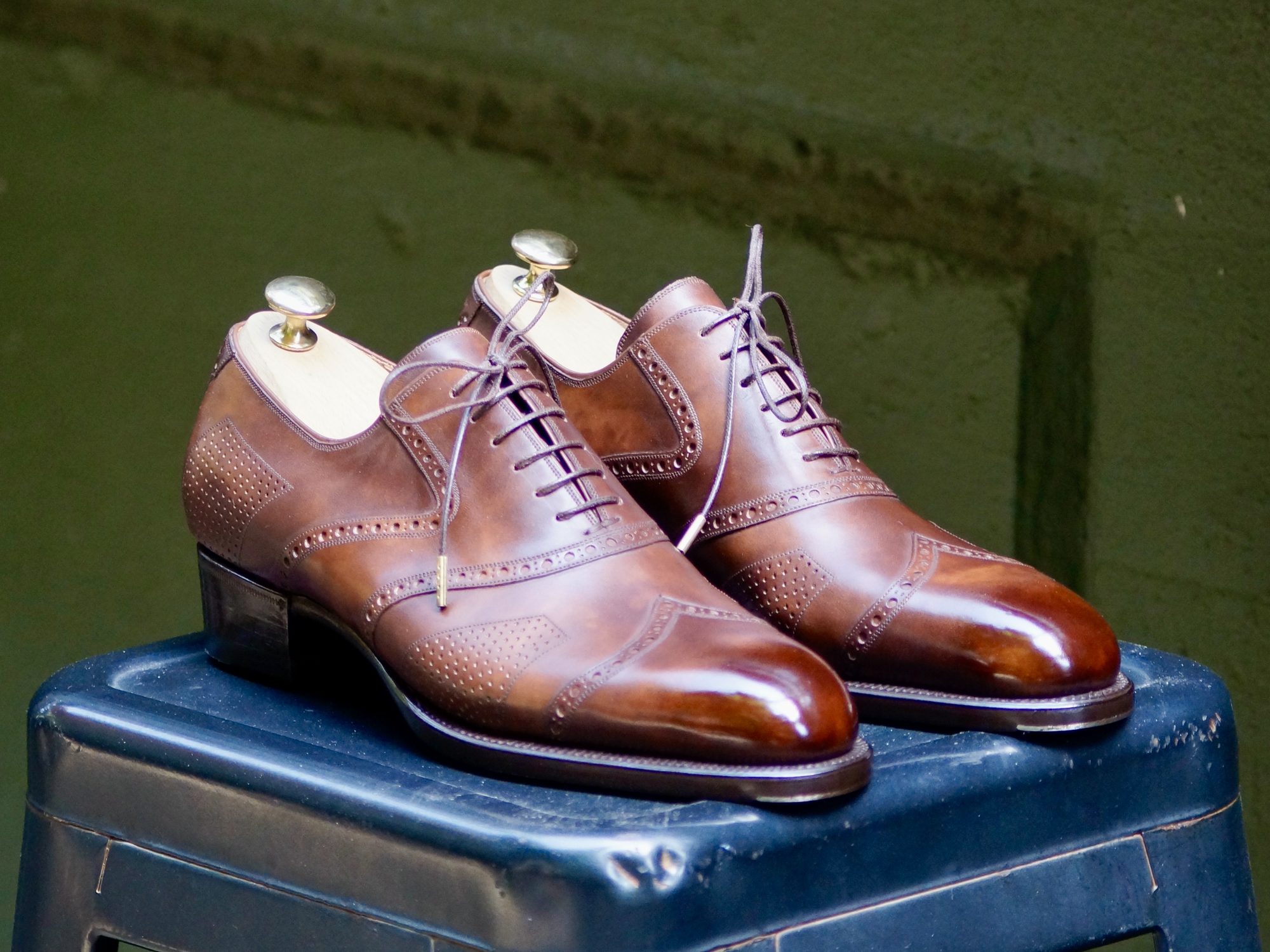
The reference points for his designs are old American shoes. “I look to and research American vintage models, drawing from those style lines to inspire and inform my work,” Waplinger says. He treats the designs of the past as a way of learning how lines are drawn.
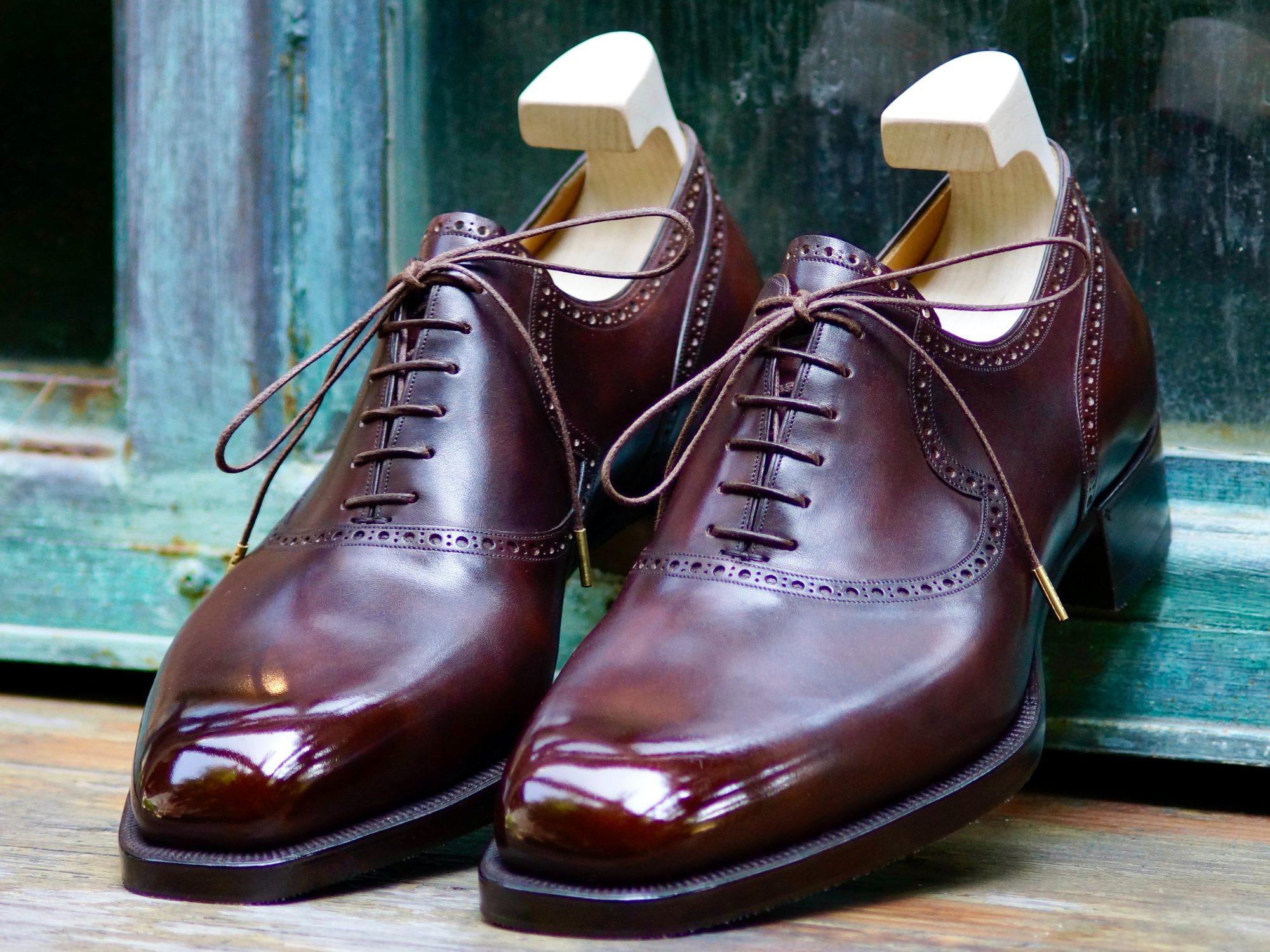
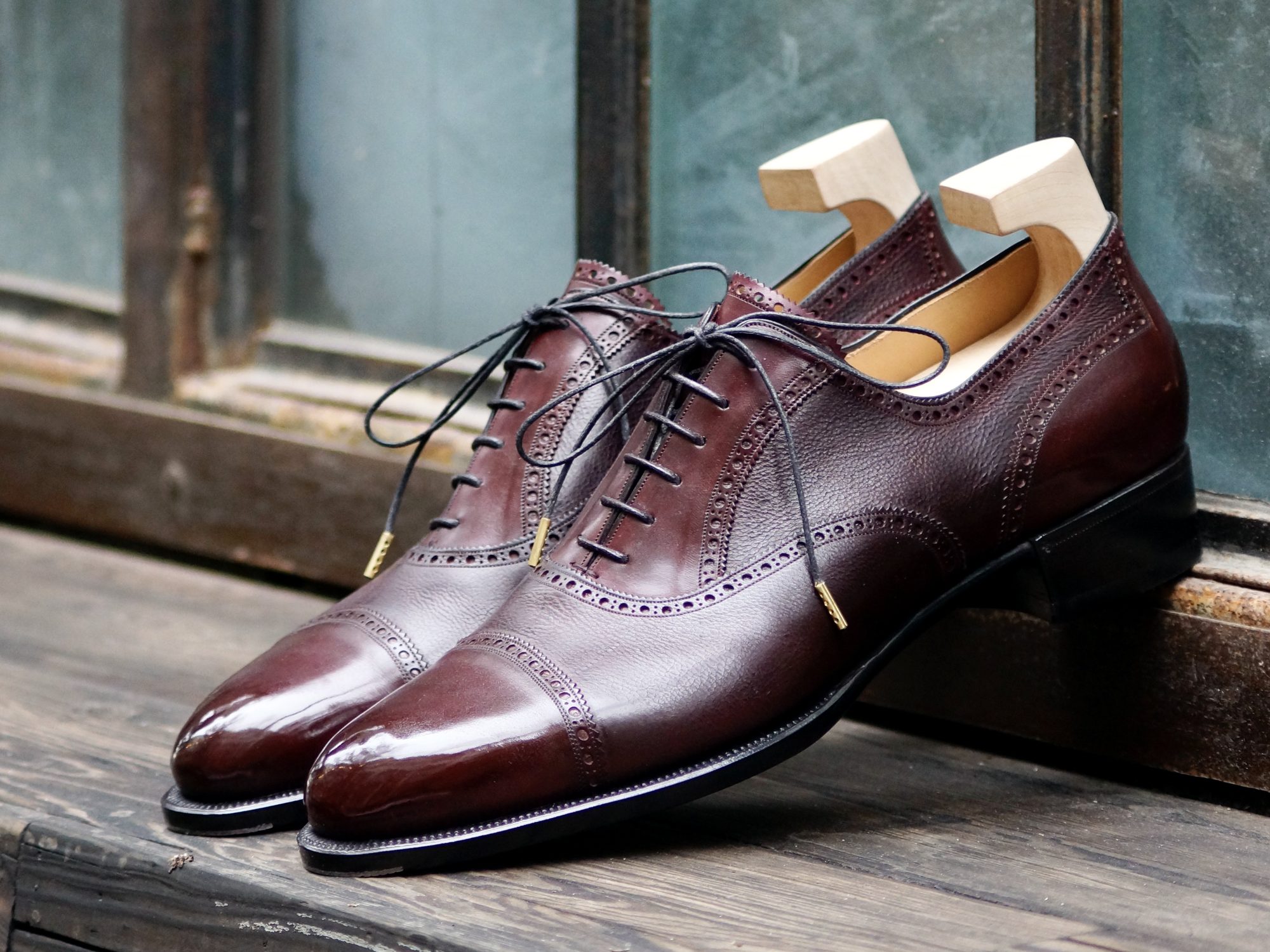
At the center of his references are shoes made in the United States in the 1930s to 1950s. The collection carries model names such as Ellington, Astaire, Crosby, Carlton, Fulton, Bainbridge, Lexington and Verrazzano. The core designs are the Adelaide, the Oxford, the Derby, the chukka boot and the saddle shoe, and the Adelaide draws on the archives of classic American shoemaking.
Model by model, the correspondence is clear. The Astaire is an Oxford with broguing, the Crosby a modern reading of the Oxford, the Carlton a model built on the saddle shoe. The Fulton and the Bainbridge are Derbies, the Lexington a chukka boot, the Verrazzano an everyday dress shoe. Among them the Ellington, the Adelaide connected to those archives, sits at the center.
A craftsman trained in Italy who traces Italian design produces a fine replica, and nothing more. By turning his references back to the old shoes of his own country, method and design come from different sources — a combination found only in this workshop.
The Road from 2010 | Art School, Florence, Independence
His career runs through three places: art education in the United States, training in Florence, and independence in New York.
The entry point came in the mid-2000s, when he began making his own footwear. In the United States at the time, places to learn artisanal shoemaking in a systematic way were hard to find, and that circumstance led him across the ocean.
After graduating from the Savannah College of Art and Design in 2010, he spent three years in Italy. Two were at Accademia Riaci in Florence, where he completed the basic and master courses in shoemaking and also served as a teacher’s assistant. The third year he spent working with Roberto Ugolini. Nearly all of his technical foundation was built during those years in Italy.
Back in the United States, he started his own business in Southampton, New York in 2015. After a period working out of a barn on Long Island, he moved to Brooklyn in 2020. His workshop is now inside Industry City.
Ninety-Five Percent | The Line Drawn with Two Apprentices
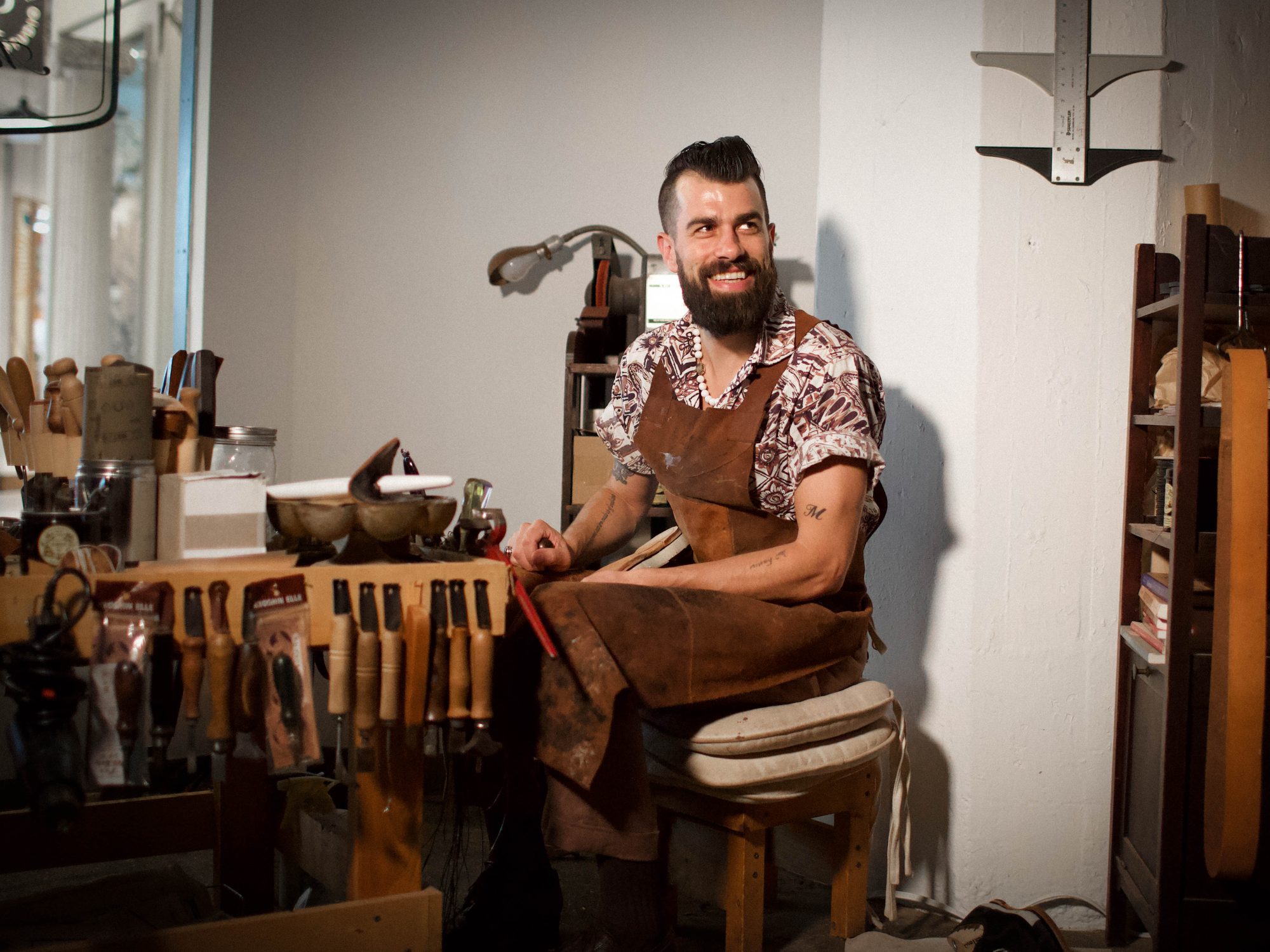
There are two apprentices in the workshop. On the final pairs that go to clients, however, Waplinger does 95 percent of the work with his own hands.
The apprentices take on the fitting shoes and the ready-to-wear line, and prepare some of the materials for the final pairs. The extra hands go to the work around the fitting rather than to its core.
Drawing the line here has a practical benefit for fit. What he reads in a customer’s feet at the measuring stage is carried straight into the last and the stitching, with nothing lost in a handover.
The work is primarily by hand, though not everything is done by hand alone. Machines are used for certain steps, such as sewing the uppers. The thinking is to concentrate time on the steps where only handwork changes the result.
The price is volume. There is a limit to how many pairs one pair of hands can finish, and the roughly 16-month lead time for bespoke is in part a consequence of this structure.
The Adelaide and the V-Cap | Lines That Keep Returning
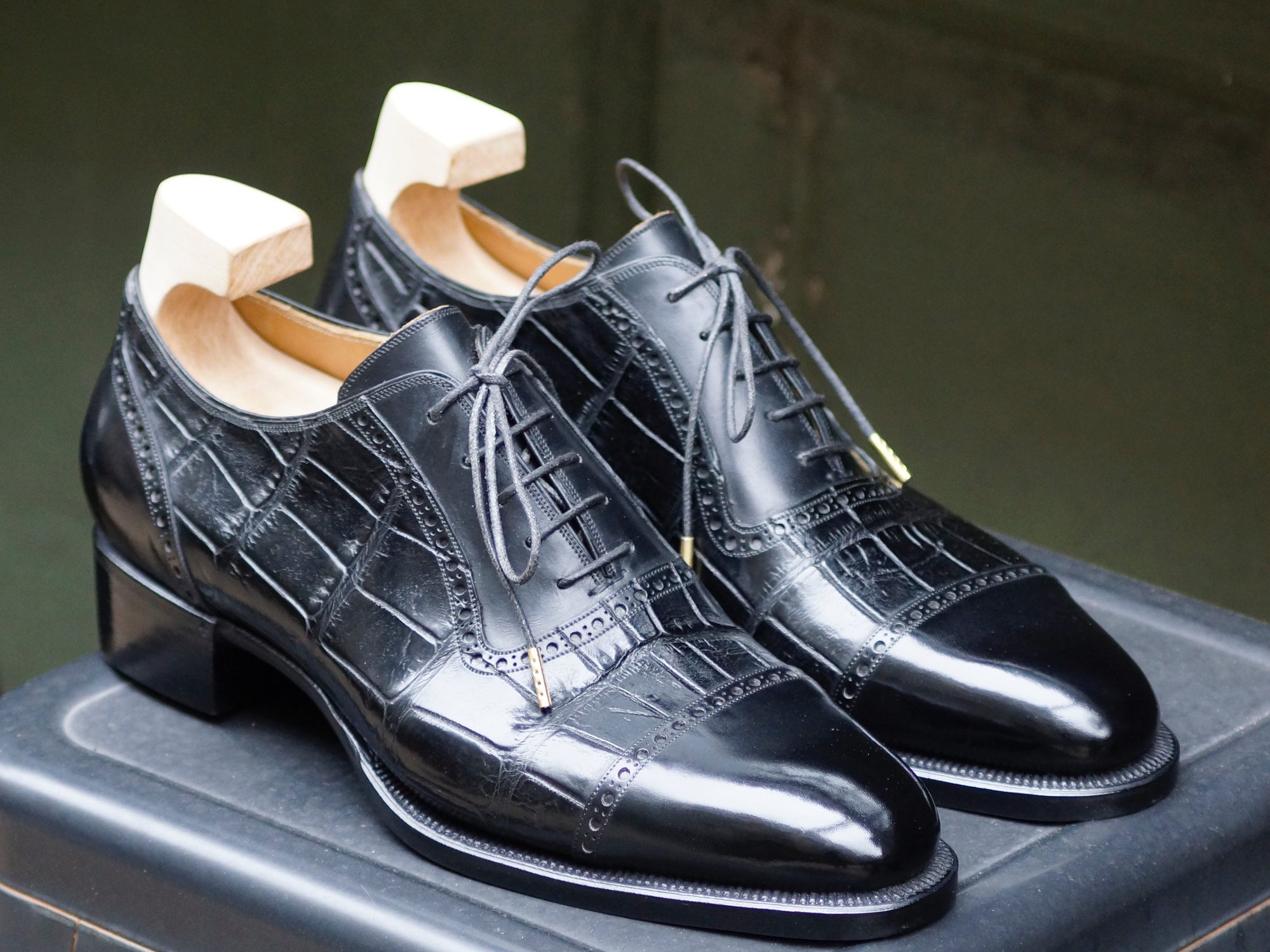
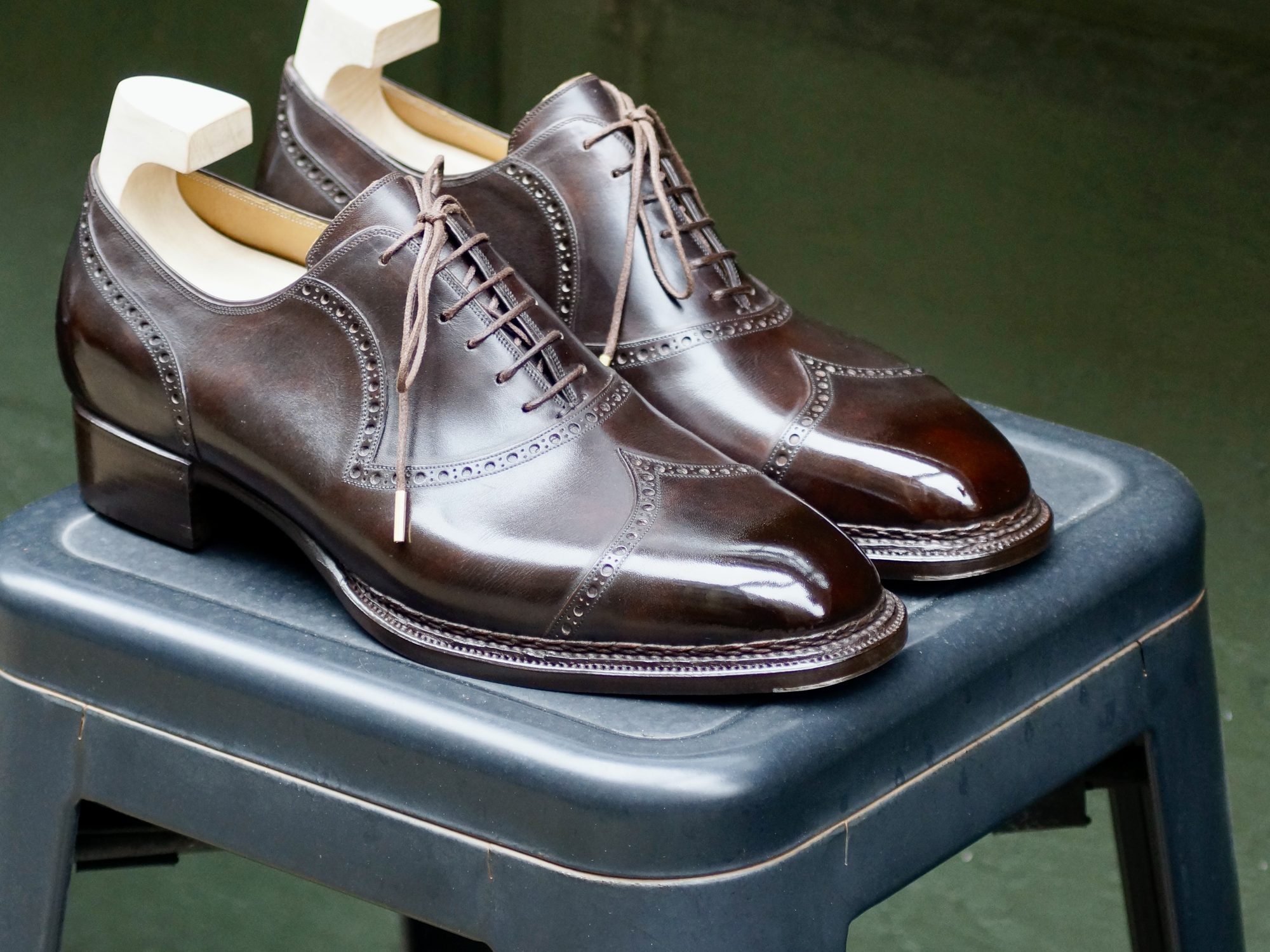
The starting point among his designs is the Adelaide. Even as leathers and colors change, the same lines keep appearing in his Adelaides.
“I always enjoy an Adelaide model. Personally, I like to use a V-cap on a lot of my patterns. I make the heel cap pattern a bit oversize so it drops into the shoe’s waist, which is another of my style preferences. It’s more common in many vintage styles.”
True to his words, two things mark his shoes seen from the side: the oversized heel cap dropping into the waist, and the V-cap at the toe. These are what make a pair recognizable as his.
The individuality of a maker who keeps working within one model shows in repetition rather than novelty. Within the classic frame of the Adelaide, Waplinger sets his shoes apart through the placement of lines alone. No small part of what arrives after a 16-month wait lies in these unchanging lines.
Why the Norwegian Construction Is Not for Everyone
Waplinger separates having a technique from using it. His approach to the Norwegian construction shows this clearly.
“I do enjoy the Norwegian construction but it’s not for every pair or every client.”
A short remark, but it touches the substance of bespoke. Norwegian welt construction is generally described as a heavy, highly water-resistant method marked by its double rows of stitching. Even so, he judges pair by pair, wearer by wearer, whether to use it. That judgment itself is something no ready-made shoe can offer.
The collection includes an Adelaide built with this construction: a classic dress shoe combined with a structure most makers reserve for boots, and combinations like this can be discussed when ordering. Sturdiness or lightness? It is the kind of choice made by working backward from where the shoes will be worn, in conversation with the maker himself.
A Personal Last, Three Fittings on Average, and What Fills 16 Months
A first pair takes shape through measuring, the making of a personal last, trial shoes and fittings, and arrives in about 16 months. Most of that time goes into the back-and-forth of closing the gap between foot and last.
There are at least two fittings, three on average. Trial shoes are walked in, the last is corrected, and only then does the final making begin. Each customer’s last is made for them and kept, so a second pair can be ordered on the same last, with a typical lead time of 6 to 12 months.
The cost and time of a first order include the building of a reusable foundation: the personal last. Later pairs come faster and cost less because that foundation already exists.
The relationship does not end at delivery. Depending on wear and condition, the soles can be replaced two to four times. A pair is designed with care and repair built in from the start.
Training the Eyeballs | A View of Apprenticeship
Waplinger locates the core of technique not in the hands but in the eyes.
“It’s hard to explain that a huge part of training is that you’re really teaching your eyeballs to see better.”
His own explanation. The slight distortion of a last, the spacing of stitches, the difference between left and right — the eye that catches these before the hands move sets the ceiling of the finished work.
In his way of speaking of methods passed down from maker to maker, you can read a sense of being part of that chain himself. From the standpoint of succession, the training of the eyes is the part hardest to put into words when the chain is handed on. The two apprentices in his workshop are on the receiving end of it now.
Provenance of Materials | Italian Sole Leather and Japanese Ramie Thread
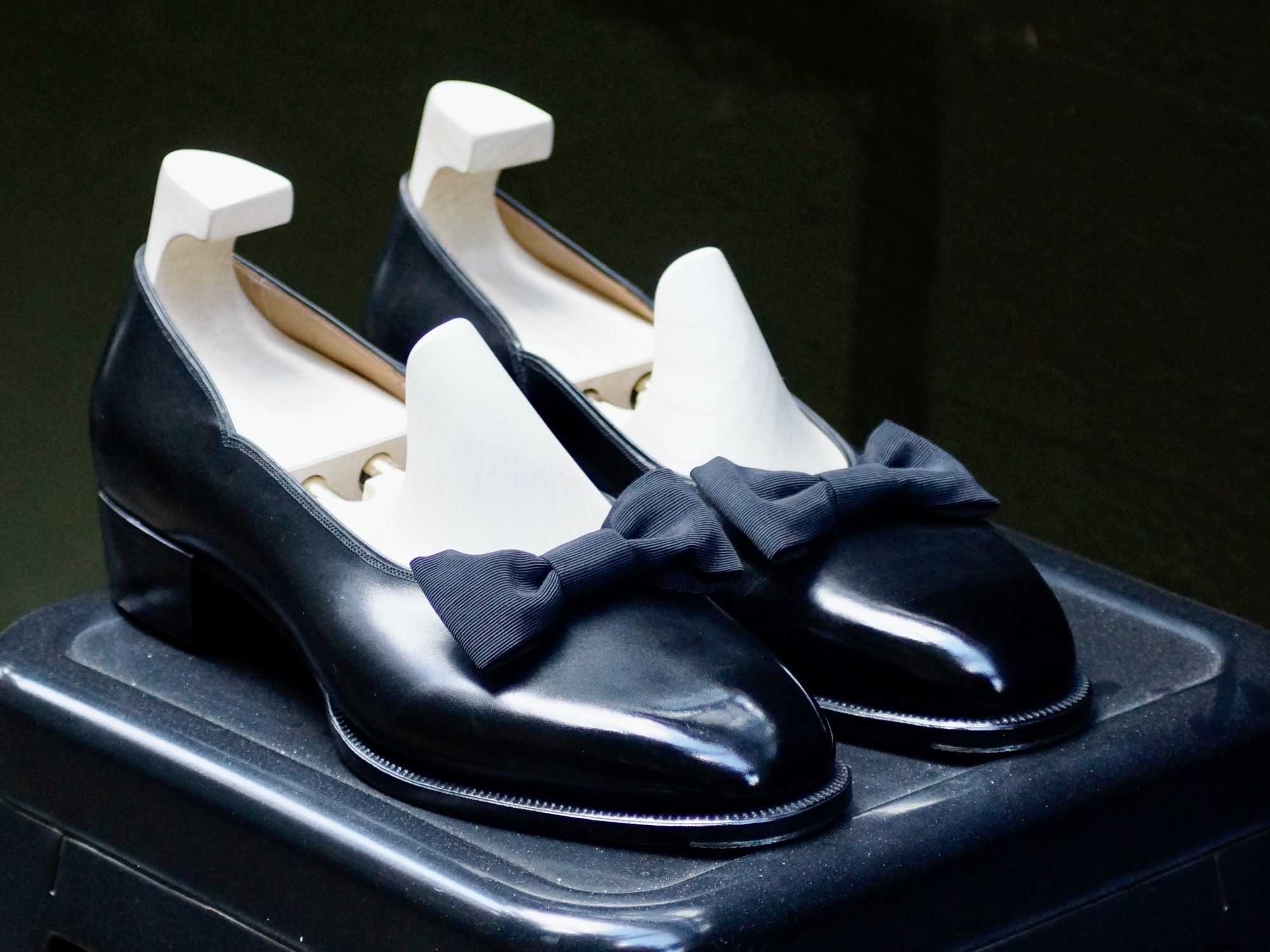
The axis of his leathers is Italy. Sole leather, insole leather and upper leathers are mostly Italian.
To these he adds leathers from Germany, England, France and the United States. Beyond calf, he works with exotic leathers such as wild boar, shark and alligator, priced by individual quotation.
There is a Japanese connection in the details as well. Hand-twisted Japanese ramie thread can be chosen for sewing the soles, on men’s and women’s shoes alike. A stance of choosing provenance precisely where it does not show: more than the breadth of the material list, that choice reflects how this workshop thinks.
Three Ways to Order, from $6,000
There are three doors into ordering: bespoke, made-to-order (MTO) and ready-to-wear.
Bespoke starts at $6,000 for shoes and $6,800 for boots, and those figures include the $700 for the personal last. From the second pair onward, shoes and boots alike are $700 less, because the last already exists. The lead time is about 16 months, and the majority of his orders are bespoke.
MTO starts at $3,600 with a lead time of 10 to 12 months. Within the United States fitting shoes can be shipped, so remote orders tend to take this route. Ready-to-wear is $2,400, carried by Robinson Brooklyn in Williamsburg.
There are official figures for additional finishing as well. An additional color is $600, patina finishing $450 for shoes and $500 for boots. Exotic leathers such as alligator are quoted individually. Different pricing applies at trunk shows.
Prices have moved. In 2021, bespoke started at $3,200; the figure has roughly doubled in five years, a number that marks where a workshop of this size, with demand concentrated on one pair of hands, now stands.
The three tiers reflect the amount of process devoted to fit. A personal last and an average of three fittings, or a choice within existing patterns — that is decided before the price is.
Notes for Customers Outside the United States
Bespoke and MTO commissions are limited to the United States.
“I only accept commissions from the United States because you need to visit in person for measurements and fittings.”
So Waplinger explains. It is a decision to keep the fitting process complete and face-to-face.
For readers outside the United States, two realistic options remain: visiting the workshop by appointment when in New York, and seeing the ready-to-wear at Robinson Brooklyn. The workshop is open Thursday through Sunday, 11:00 to 18:00, and appointments are also available at Robinson Brooklyn.
The terms are worth knowing in advance. Commissions require a non-refundable 50% deposit, with tax and shipping charged separately.
Note also that sneakers, western boots and women’s high heels sit outside his specialty. Whether a design you have in mind falls within his range is best discussed before booking.
What Continues in Brooklyn
Waplinger’s work, in a phrase, is the reconnection of two traditions. Italian method and American design are bound together at one small point: the wooden pegs in the waist.
More than a decade has passed since he set up on his own in 2015. Even with two apprentices in the shop, the finishing of each pair that goes out, and the responsibility for the two to four resoles to come, stay in his hands. Seen as a matter of continuity, the value lies in this way of lasting rather than in scale.
The roughly 16 months are the time it takes for a record of your feet to become a last, for trial shoes to confirm your stride, and for the pegged waist and the V-cap lines to settle into a single pair. At the end of it, the shoes become a classic in the shape of your feet.
Workshop Information
Francis Waplinger
Location: Brooklyn, New York, United States
Orders: Bespoke / MTO (United States only) / Ready-to-wear (available at Robinson Brooklyn)
Price range: Bespoke shoes from $6,000, boots from $6,800 (personal last included; $700 less from the second pair onward) / MTO from $3,600 / Ready-to-wear $2,400
Lead time: approx. 16 months for bespoke / 10–12 months for MTO
Website: franciswaplinger.com
Instagram: @franciswaplinger_shoemaker
More Craftsmen
Sponsorship Information
“The Makers Guild” is an international community site that shares craft and shoe culture. We are currently welcoming sponsorships from partners who support our mission.